


How to make sense of a food label
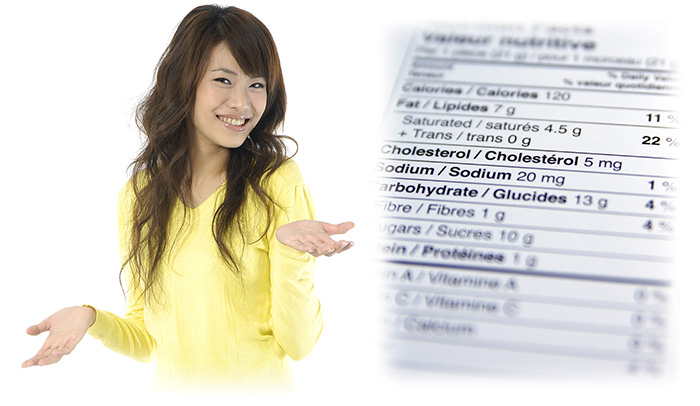
Nutrition labels mess with our heads. In a recent survey by Student Health 101, three in five students who responded said that they “sometimes, often, or always” find food labels difficult to interpret and apply to their own life and needs. What does 4 oz. look like? Which matters more, low sodium or low fat? “You might think everything is on the label but it’s not, or ingredients might be listed in a sort of code that you practically need a degree just to figure out. It is so much work to read and truly understand the label,” says Alaine W., a student at Moorpark College, California. Here’s how to get what you need from a food label.
1. Serving size
Often, serving size is not obvious. Servings can add up quickly, especially in processed foods. Individually wrapped servings simplify the label but add cost and packaging waste.
Servings per container Check the number of servings per container to find out how many servings you are actually consuming. Sometimes a serving size is unrealistically small.
+ Serving sizes then & now
+ Visual guide to serving sizes
2. Calories, total fat, total carb, & protein
These numbers are overrated. Most of them are less important than nutritional quality, and you can get a better sense of that from the ingredient list.
Dietary fibre is the exception. Most Canadians don’t get enough fibre.
- Good fibre source: 10% of your daily value
- High fibre source: 20+% of your daily value
All fats are not created equal. Watch out for hidden trans-fats, , e.g., “hydrogenated” and “partially hydrogenated” oils. These are harmful. You might find them in peanut butter, salad dressings, snack foods, candy, and other processed foods. It is legal to say foods have “zero grams of trans fat per serving” if they contain less than 0.5 grams per serving. Those small amounts add up if you eat them routinely.
Protein is not generally a health concern; most Canadians get enough, if not more than we need.
3. Sugar & sodium
Sugar is tricky to track. Food labels tell us how many grams of sugar are in a serving but give us no guidance about how much sugar we can safely eat.
Sodium adds up quickly. Foods considered “low sodium” contain less than 300 milligrams (mg) of sodium per serving.
4. Vitamins & minerals
Look for “% Daily Value.” Rule of thumb:
- 15% or more: This product provides a high proportion of this daily nutritional requirement.
- 5% or less: This product provides a low proportion of this daily nutritional requirement.
5. Ingredients
Generally, less is more: Fewer ingredients usually mean the product is less processed and contains more whole foods. Ingredients are listed in order of quantity, from highest to lowest. Pay attention to the first five ingredients. Try to avoid foods with sugar near the start of the list—and be aware that sugar has more than 50 names.
How food labels mess with our heads
According to a recent Student Health 101 survey, students struggle most with:
- Knowing which nutritional elements to prioritize
- Misleading packaging terminology (e.g., “natural”)
- What the percentage Daily Value (DV) means for you
- Comparing similar products and knowing which is healthiest
“Companies list an ingredient using the chemical name instead of the common name, like listing ‘sodium bicarbonate’ instead of ‘baking powder.’”
—Katie F., Mount Allison University, New Brunswick
“I recommend that people choose foods with no food labels. Those are the fresh, whole foods that aren’t in a package. If a person doesn’t know the nutrition facts for a food, or if the food is ultra-processed, move on and choose something less processed. Simple is the best path most often.”
—Abby Langer, RD, St. Joseph’s Health Centre, Ontario
How students use food labels
In a recent survey by Student Health 101, one in four students who responded said they “always or frequently” check food labels (usually for general health and nutrition reasons, sometimes for specific medical reasons including allergies). Only 9 percent rarely or never check food labels.
When are you most likely to read food labels?
When you are:
- Trying to eat healthier
- Considering an unfamiliar food item
- Dealing with a food allergy or intolerance
- Learning something new about nutrition
- Considering sugar content or serving size
When are you least likely to read food labels?
You are least likely to consult labels when buying for a party or special occasion.
“When going to a party, it can be helpful to eat before arriving. This can control cravings and help you make more conscious decisions. Also, consider how the [food] was prepared; was it fried or baked? This can give you a good indication of which item is a better alternative.”
—Victoria Craig, RD, Stratford Family Health Team, Ontario
See UCookbook for demos of healthful, delicious desserts

