


What’s up, sugar?
Quiz: Sugar’s about to get real
 |

Sugar is confusing on so many levels. Is it natural to the product or added—and does that matter for our health? (Yes, up to a point.) Why don’t food labels tell us how much sugar we can safely eat? (In part because that would be the death of the sugar industry.) What about all the different names for sugar: Are cane juice crystals sugar? How about sorghum syrup? Dextran? Barley malt? (Yes, in all cases.)
One thing we can safely assume: “We eat way too much of it,” Dr. Yoni Freedhoff, an obesity expert in Ontario and best-selling author, wrote in a 2014 column in The Globe and Mail. Sugar meets the criteria for being a legally regulated substance, says Dr. Robert Lustig, an expert on the harms of sugar at the University of California, San Francisco. “We have a limited capacity to metabolize it—virtually like every poison, kind of like alcohol. So a little is OK; a lot is not,” Dr. Lustig told Vox last year.
The World Health Organization (WHO) recommends reducing our daily intake of added sugars to less than 5 percent of our total energy intake (calories consumed). For example, if you consume 2,000 calories a day, aim not to exceed 25g (6 teaspoons) of added sugars. Natural sugars are usually less concerning.
For each pairing, CLICK the item that you think has more sugar.
If this leaves you feeling icky-sweet, check out the #fedupchallenge and try to make it through 10 days without added sugar.
1 Double Stuf Oreo® OR Burger King Whopper®
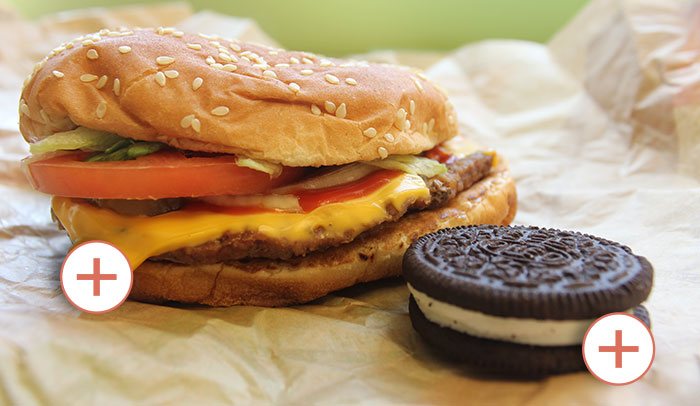
The Whopper® has a whopping amount of sugar—more than your cream-stuffed Oreo®.
In a recent Student Health 101 survey, more than half the students who responded thought the Oreo® contained more sugar. Not so much. The Whopper® is a sugary mess and the bread is the culprit. Take away that sesame seed bun and the sugar in your burger falls from 11g to 4g. Most of the bread we eat in Canada contains added sugar.
The Burger King Whopper® contains the disruptive triad of sugar, fat, and salt. When these three ingredients are combined, they affect the brain like a drug, according to a 2013 study by researchers at the University of Bordeaux, France. You aren’t lazy and lethargic; it’s the food that makes you feel that way. To stay energized and maybe live longer, eat fast foods sparingly.
+ Try a reverse food log. Reward yourself for the sugary stuff you avoid.
1 Double Stuf Oreo®—6.5g
Burger King Whopper®—11g
The World Health Organization (WHO) recommends not exceeding 25g of added sugar in a 2,000 calorie diet.
Danone® Oikos® 0% Cherry Greek yogurt OR 1 serving of Campbell’s® Creamy Tomato Soup
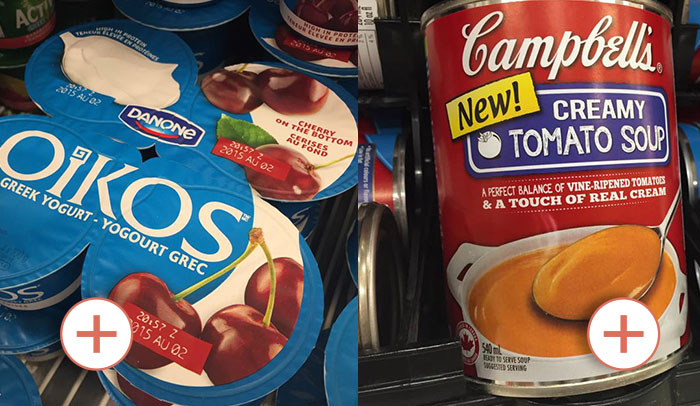
This one is tricky, but that comforting bowl of tomato soup has more sugar.
We’re not the only ones playing tricks. The food industry sometimes tricks you too by adding ingredients you don’t recognize into your food.
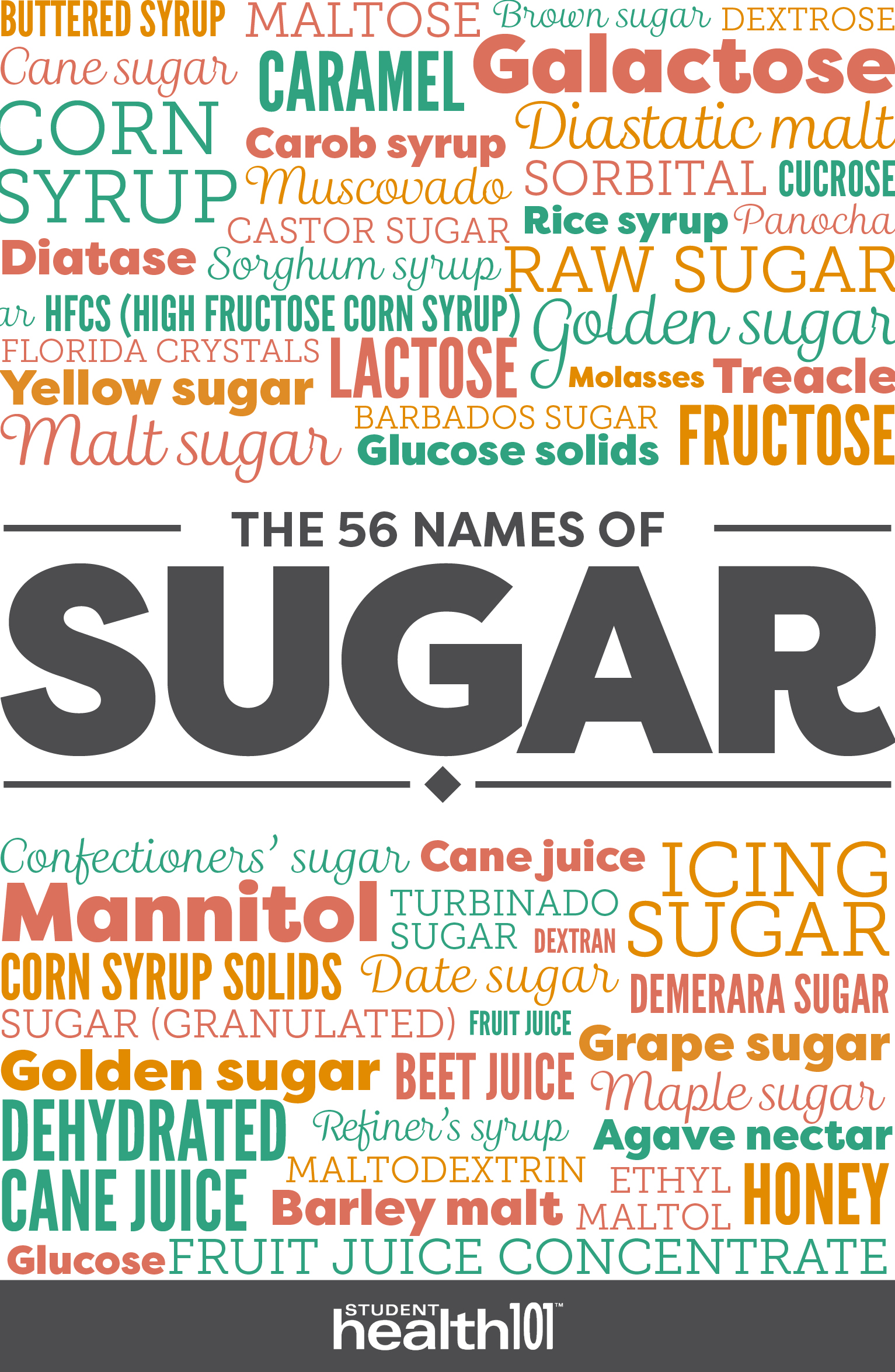
There are almost 60 different names for sugar listed on food labels, according to Sugarscience.org. If you don’t feel like tattooing the list on your arm, check out our Pinterest panel to the right.
Don’t make the mistake of assuming that honey is a healthier alternative to sugar. If you want to sweeten your plain yogurt, add a small amount of honey and embellish with fresh fruit, seeds, etc. This way you’re in control of how much sugar is added to your food.
Ready to take it a step further? Go European and live on fruit, vegetables, legumes, fish, and nuts and seeds. The Mediterranean diet is among the healthiest on the globe. This diet reduces the risk of death from chronic diseases, according to a 2008 meta-study in the British Medical Journal.
Danone® Oikos® 0% Cherry Greek yogurt—11g
1 serving (250 ml) of Campbell’s Creamy Tomato soup—16g
The World Health Organization (WHO) recommends not exceeding 25g of added sugar in a 2,000 calorie diet.
500 ml of Allen’s® apple juice OR 500 ml Gatorade®
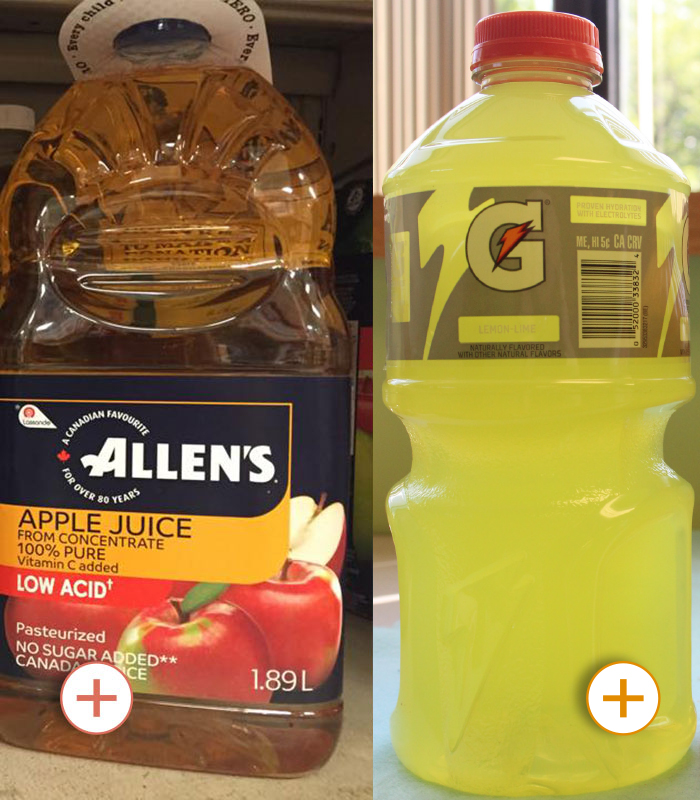
Fruit is good, but fruit juice usually isn’t. This apple juice contains more sugar than Gatorade® does.
In our survey, 55 percent of students went with the apple juice. Correct.
Even natural sugars can be concentrated in unnaturally high doses—as in fruit juice, which lacks the fibre that helps us metabolize natural sugars. If you routinely drink sugar-sweetened sodas or fruit juices, cutting those out will drastically reduce your sugar consumption. These drinks make up 36 percent of the added sugar we consume, according to SugarScience.org. Instead of fruit juice or sodas, eat a piece of fruit with a glass of water.
About those sports drinks: Unless you’re a high-intensity performance athlete, you probably don’t need to replenish your electrolytes. Stick with the no-sugar alternative: water.
500 ml of lemon-lime Gatorade®—30g
500 ml of Allen’s® apple juice—50g
The World Health Organization (WHO) recommends not exceeding 25g of added sugar in a 2,000 calorie diet.
1 medium banana OR 1 KIND Fruit & Nut bar
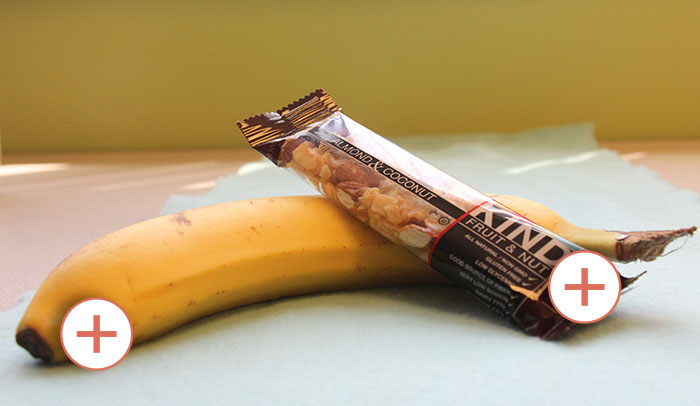
The banana has more sugar, but don’t hate on it.
In our survey, two in three students thought the KIND bar has more sugar. Surprise! It’s the banana—but only by a few grams. This doesn’t mean you should stop eating bananas. Those sugars are natural, and they are tied to the fibre in the fruit, so we avoid the blood sugar spike that comes from added sugars. Also, fruit is packed with nutrients.
Focus on checking the labels of all manufactured food products, including anything that’s being marketed as healthy—like fruit-and-nut bars. An estimated 35 percent of Canadians’ sugar intake comes from added sugars, according to Statistics Canada’s analysis of the 2004 Canadian Community Health Survey. Common sugar sources include processed and packaged foods, such as soft drinks, candy, cereal, and—you know where this is going—that KIND bar.
+ To see how much sugar Canadians are really having, check out this infographic from MacLean’s.
1 KIND Fruit & Nut bar - Almond & Coconut—10g
1 medium-sized banana—14g
The World Health Organization (WHO) recommends not exceeding 25g of added sugar in a 2,000 calorie diet.
1 medium Tim Hortons Iced Capp™ OR 1 can Coca-Cola®

That coffee concoction might as well be an ice cream sundae. The Iced Capp™ has more sugar than a can of Coca-Cola®.
When it comes to sugar, the coffee drink trumps the soft drink, and that’s not going to change any time soon. Coca-Cola® plans to cut the sugar in its product sold in Canada from 42 grams to 37 per can. But don’t expect the sugar slash to up Coke’s nutritional value.
Blended coffee drinks are packed with sugar, but at least you can remember that you had one. The Coke taste is “forgettable,” according to research at Givuadan, a flavour and fragrances manufacturer in Switzerland. Coke ranks higher in popularity than pop drinks that have very strong tastes. We can drink several in a day and not get tired of the taste. If you’re a pop fan, you may find it easier to limit your intake if you stick with more vibrantly-flavoured options.
+ Where else does sugar hide? Take a look
+ Down with cooking? Try these creative ways to reduce your sugar intake.
Medium Tim Hortons Iced Capp—47g
1 can (355ml) of Coca-Cola®—42g
The World Health Organization (WHO) recommends not exceeding 25g of added sugar in a 2,000 calorie diet.
1 serving whole milk OR 1 Newtons cookie—fig
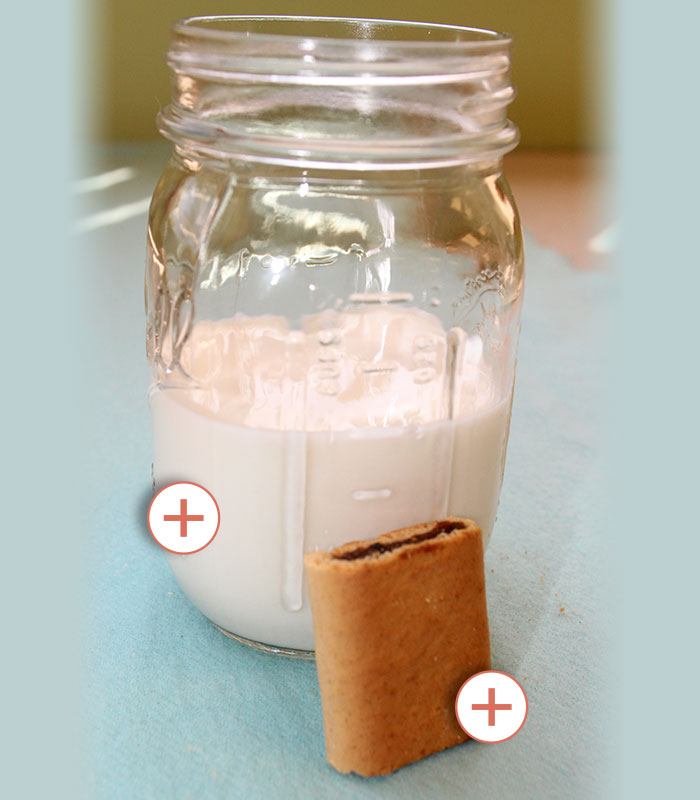
Reconsider your childhood. Milk and cookies? Your glass of milk actually has more sugar.
In our survey, just one in three students got this right. Let’s be clear: Milk is a good source of nutrients. The sugar in milk, lactose, is natural (straight from the cow). Where you’ll run into trouble is with flavoured milk that averages 4 teaspoons of added sugar per serving. One box (200 ml) of Nestle® Nesquik® Chocolate Less Sugar Ready-to-Drink low-fat milk has 16g of sugar—which by itself brings you more than halfway to the 25g daily limit.
Many products, like chocolate milk, contain natural and added sugars. Manufacturers are required to tell us the total amount of sugar in their products, but they don’t have to tell us how much of that sugar they’ve added.
1 Newtons cookie - fig—6g
1 serving (250 ml) of whole milk—12g
The World Health Organization (WHO) recommends not exceeding 25g of added sugar in a 2,000 calorie diet.

